
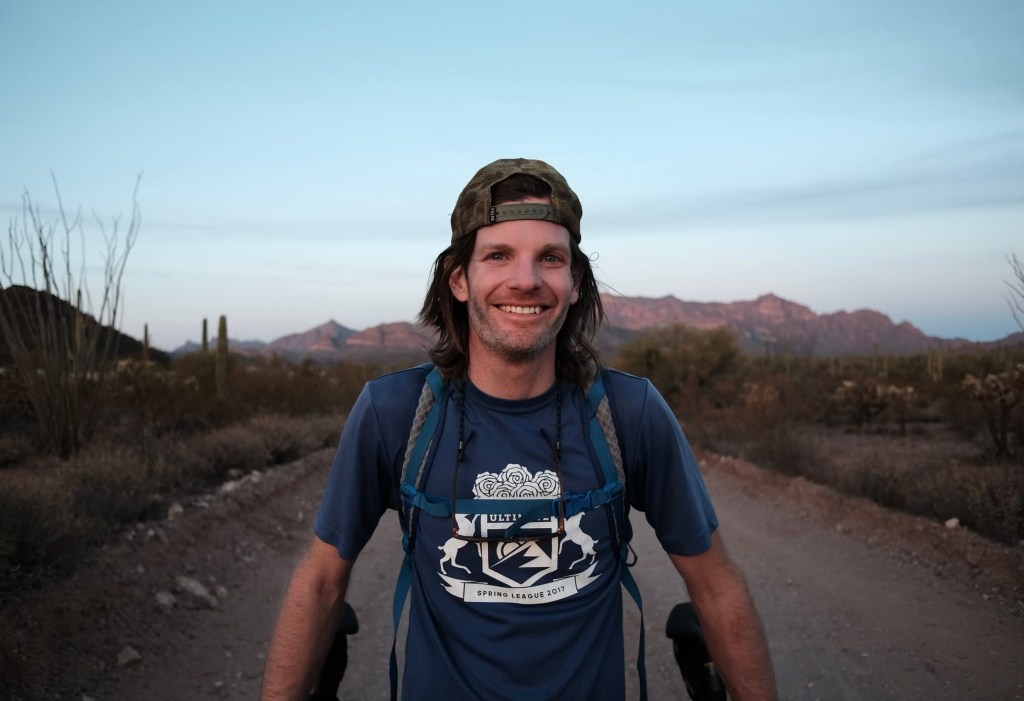
NORTHER: Can you start by telling us about your relationship with nature and how it has progressed through your life?
AARON: Maybe this is true for most people, but my relationship with nature has changed a lot throughout my life.
I think as a kid growing up in the concrete suburbs of Dallas, Texas, I just knew that I liked playing outside, but nature was a fairly abstract concept to me. It wasn’t until really when I moved to Oregon in my twenties that I started experiencing “nature” in a more real and specific way.
I feel most at home and most grounded when I’m out in a wild, remote place, especially by myself. It feels really important to put myself in a super remote situation alone- at least once a year, but ideally several times a year. Where I’m spending a few days alone, beyond the reach of cell service.
I love all different kinds of landscapes. I love the desert. I love the rain forest of the Cascades. I seek out a lot of different kinds of experiences.
NORTHER: What are some of the places that feel like home to you in the outdoors? Do you wanna talk a little bit about your background in the outdoors and give some context for your depth of experience.
AARON: I would say Mount Hood, which is like the first place where I really spent a lot of time outdoors. Parts of Joshua Tree, and more recently, Death Valley, are places where I’ve found that sense of home in California. I love the Mojave desert.
In my late twenties, I started backpacking with some friends who kind of brought me out on longer trips. And then over time, through friends I started taking on more intense hiking and backpacking trips and bike tours. And then over time, I started making different friends who did more intense things outdoors.
I did a portion of the Sierra High Route through the southern Sierra in 2018 with a couple of friends and that was kind of a peak experience for me. It was just traveling a long distance over very uncertain terrain, following a rough line on a map that might take you through some pretty adventurous spots. That kind of opened a new world to me. I started doing more trips like that off-trail and then planning shorter ones solo.
I also started working for the National Park Service as a historic preservation carpenter in 2017, first at Mount Rainier, then on the Channel Islands in California and then at Point Reyes.

NORTHER: Amazing. If you’re ready, can you tell us about the accident you had?
AARON: In the fall of 2021 I had just wrapped up a Park Service gig and I wanted to do this big solo off-trail adventure in the Inyo mountains. It’s called the Lonesome Miner Trail. It follows some unmaintained trails, old jeep trails, mule paths, footpaths that connect some early 20th century, late 19th century mining camps.
Inyo Mountains is this really stunning, rugged range east of the southern Sierra. So it’s like across Owen Valley from Mount Whitney. Because it’s in the shadow of the Sierras, it doesn’t get as much attention. The Inyos form the western boundary of Death Valley National Park.
Anyway, I was gonna do about 44 miles, something like that over three days. I had planned the trip out as much as I could based on known year-round water sources, springs, but all I had with me for navigation was basically downloaded maps on my phone. I think I printed out a map too.
Before I lost cell service, I sent the GPS coordinates of my truck to my partner. I sent her the GPX file of my route and told her when I was due back and that if I wasn’t back by X time, um, that something was up and she should call the local sheriff. I gave her the number for the local sheriff and, and then that was it. I put my phone on airplane mode and I started hiking.
Pretty quickly, I realized that the GPX file I had found online for this route kind of shortened the distances a little bit. Um, like just enough that it made a significant difference in how much daylight I was gonna have especially at the end of that first day.
I’ve always kind of described myself as an irrational optimist. I think it’s generally one of my better qualities, but it doesn’t always benefit me, for sure.
At the end of the first day, I filled up all my water at a little spring where there was some ancient mining equipment. I was hoping the water was good- you never really know. This isn’t industrial mining, this is like, you know, two guys and a mule situation, but you never know. Enough people have hiked this before and, like, apparently not died that I just trusted it.
Part of the allure of this hike is just that, like, I love old abandoned mining camps. I think that stuff is super cool. I love that the desert just kind of preserves things in a way that the Pacific Northwest just doesn’t. So you can come across like some pretty sweet old artifacts that, in some cases, have been untouched for a really, really, really long time.
This hike was an opportunity for me to encounter a bunch of that stuff, and some old mining cabins that some volunteer groups have kind of halfway maintained over the years. My route was just kind of stringing together these old cabins.
So, this route is like, you know, thousands of feet of elevation drop and then thousands of feet of gain and then, like, you lose it again and then you gain it again. It’s not a traverse, it’s up, down, up, down, up, down and it was intense. I think I underestimated what my speed was gonna be doing this.
So, that first night, I’m starting to climb up and out of this big drainage, this canyon, we’ll call it. I started losing daylight. This is late October, so the sun is going down, you know, like around six, something like that. I ended up hiking several hours past sunset in order to get to my next water source. Normally, if there’s any moonlight, I love hiking at night by moonlight when I can, we talked about this before. I know you like to do this too.
So, this could have been one of those hikes, but there was no moon whatsoever that night, or at least it didn’t come up early enough to be of any use to me. I was in just total, total blackness and it’s a remote enough place that there’s no light pollution to help either really. Um, you know, this is maybe the only time I would have ever welcomed it.

So, all I had with me was my head lamp and, um, and headlamps aren’t that good- you lose a lot of relief if the light is on top of your head, because you can’t see shadows, right? It’s all washed out. And so, if there’s no trail, which there wasn’t in this case, then it’s really hard to make out a slightly discernible footpath, which is all there was in places. So, I had my headlamp and then the GPX route on my phone that I’m following, my little blue dot in relation to a line on a map.
I’m seeing where I think I need to veer off to start coming up and out of the bottom of this drainage. But the terrain just doesn’t look quite right. So, I kept going and then finally at some point, I’m like, “Man, I definitely passed it, I just need to start going up.” And, so, I started climbing up and out of this, this 1500’ screen slope.
Basically, it just, it sucked, this big, tall boulder mess. And, um, the wholetime, I’m like, “man, this sucks, this is not fun.” I just wanted to get to a flat. I was so tired. I’ve been hiking all day. I was hungry, I was thirsty, I was drinking way more water than I should have been.
I can’t make camp anywhere on the slope because it’s all pretty unstable. I just have to get to the top. I’m realizing as I’m going up that I’m a little bit off from my route, like probably 100, 150 ft, something like that. But between me and where I should be is like this vertical face that’s getting taller as I’m going up. I’m like, just hoping that at the top it’ll become easy enough for me to get back to where I need to be. But, um, that’s not what happened.
We all have physical limits somewhere, but our brain is the only thing between us and our physical limits.
So I get to the top of this slope and then I’m just faced with vertical rock all around me. I was contemplating my options- like, “ok, it’s maybe 20, 25 ft tall and it’s super featured and like, I am um, just reckless enough and just enough of a skilled climber that I think I can probably make it up. Like, ideally wouldn’t, but, I think I can probably do it and I’ll probably be fine.
Which is like, not good enough, right? That’s not good enough when you’re by yourself, and you don’t have any means of communication. Like you should be protected if you’re climbing something that sketchy and you should at a minimum, have, uh, maybe climbing shoes and like a helmet and a way to communicate. But I had none of that.
Um, and so the alternative was like, you know, I could just turn around, head back to the bottom and camp out in the bottom of this drainage. And just like, call it off, or at least cut my trip very short. Or, I could go back down and around and then back up the other way. But, I was too tired for that. I was exhausted. I was not in a good mindset for decision making.

NORTHER: Do you think that your decision making was just clouded by being exhausted or was there layers of frustration in there too?
AARON: Yeah, it was a lot of exhaustion. And, like I’m stubborn. I was in this bullish headspace, just like pushing myself up this steep screen slope. You know, it’s like, “cool, huh I just did that super intense push and now I have to turn around- hell no. I’m gonna find a way forward.
And the other part is that, I would say I didn’t really have what you might call a healthy fear of heights. I think that what I lack in rock climbing skill, I make up for in lack of fear of heights. It helps me push myself to do hard things. And, that’s all well and good when you’re on a rope, when you’re protected, but it’s not a virtuous quality when you are in a really unsafe situation, when you’re choosing to do a really unsafe thing. And this was one of the more extreme, unsafe decisions that I’ve made. I didn’t want to give up. I was all the way out here. I didn’t wanna cut my trip short. Like, if all I have to do is just climb this 20 feet of sketchy rock, I think I can probably make it up just fine. I’m gonna do it.
With so many hard things, if you just commit to the thing and you just decide failure is not an option, then a lot of times your mind will subconsciously do the things that it needs to do to like grab that next hold or do that skateboard trick or whatever. I think I just had this false confidence of what I could do on just sheer willpower alone.
So, I started climbing this thing and pretty quickly realized that the way that rock breaks it just didn’t create good holds. So, even though it looked really featured, it wasn’t in the right ways. And I’m in hiking boots and carrying a full heavy pack with, like, I don’t know, a couple liters of water, and all the food I needed for several days, etcetera.
So, I’m heavy and I’m in the wrong shoes, but I’m pressing forward because, like, I think I can. Pretty soon I get to the point where I’m fully committed. Like, down climbing is fully not an option. There’s absolutely no way I’m gonna down climb without falling.
And so, the only way forward is up. So, I get maybe 15 ft or so up the slope, I’m like, at least three quarters of the way up. The tips of my boots are precariously hanging on, I’m looking but I don’t see any foothold. I do see some solid, solid-ish looking handholds and so I’m like, “all right, well, like fuck me, how the fuck did you get yourself in this position? You dumb ass! What the fuck were you thinking?”

It’s just hitting me how stupid this is and how likely this is to not end well for me. And so I’m like, “OK, well, the only way forward is up.” So, I kind of launched myself up to grab the next two handholds, and I caught them. I landed it, but like, I couldn’t hold on long, right?
As I released one hand to go for the next hold, my right hand slipped and then I was just in free fall. I just remember having this panic, feeling just sheer terror. I am falling to my death right now. Like it was just long enough of a fall to lose your stomach and where you know this might be the end. And it was just terrifying.
My right foot broke my fall, it hit a rock, and you know, at this point, I’ve got quite a bit of momentum. So, my body flips pretty violently onto its side and then I just start tumbling, uncontrolled down the slope. This whole time I am just bracing myself in sheer terror. “This is it, this is how I die.”
I tumbled another 20 or 30 ft, just spinning down the slope, and then just out of nowhere, this spindly sage brush, just like, caught me. My backpack landed hard against it and I was just like, holy shit. No way. I’m alive.
I just jumped up on both feet and I was like, “I’m OK!”, like screaming out into the night, “I’m OK!”
I couldn’t believe it, I couldn’t believe I survived the fall. That was when I started noticing some discomfort, let’s call it, in my right foot. There was too much adrenaline for it to be pain yet, but it kinda just felt like my boot was on crooked, but I kinda knew like that’s probably not what’s happening.
I started feeling a little bit of weirdness in my left ankle. And so then I’m like, “OK, fuck. I might not be going anywhere.”
I pulled off my right boot, which is arguably not the right thing to do in that situation. I saw that my foot was like, basically, it was bent. My first metatarsal was sticking up, pressing against the skin but not through the skin. It kind of distorted the whole shape of my foot.
I feel most at home and most grounded when I’m out in a wild, remote place, especially by myself. It feels really important to put myself in a super remote situation alone- at least once a year, but ideally several times a year.
And I was like, OK, I’m gonna be here for a while. I need to figure out how to make this comfortable. I started moving some rocks around me to try to create this torso-length flat spot that I could lay down on. There was this super tiny, spindly little bush there that I could kind of hang my right foot from just to keep it elevated somewhat. And then I just kind of laid down.
I was like, “ok, it’s Thursday night, I’m not due back until the end of the day, Saturday. The earliest someone might come looking for me is Sunday morning and if it’s 8:30 p.m. now, then let’s call it 60 hours that I’m gonna just be laying here waiting for a helicopter.”
But like, I’ve given my partner all of the right info. As long as everything goes according to plan, I’m gonna be rescued. I’m gonna be ok, but like, fuck, this sucks. Pretty soon, the adrenaline started wearing off, my foot started swelling up and then it just became this excruciating pain, 11 out of 10. My left ankle really only hurt if I put any weight on it, but my right foot just hurt constantly. I was like, “I just have to count down from 60 hours, just lay here and, you know, just wait this out.”
But the thing is, I had drank so much water on my way up that I didn’t have a whole lot left, and this is the desert. I am gonna be exposed in the daylight. I don’t remember how much water I had left, maybe it was a liter and a half. I pretty much went through it or went through most of it the first day. And I should have been drinking like a gallon a day, right?
The first day, the sun starts coming up and it’s on me. I tried with all my might to scoot over just to the edge of the little canyon there where I could get some shade.
But the pain was just too intense. I didn’t have any painkillers of any kind. I had this bare little first aid kit. I pack a much more robust first aid kit now. I didn’t even have Ibuprofen. It was stupid.
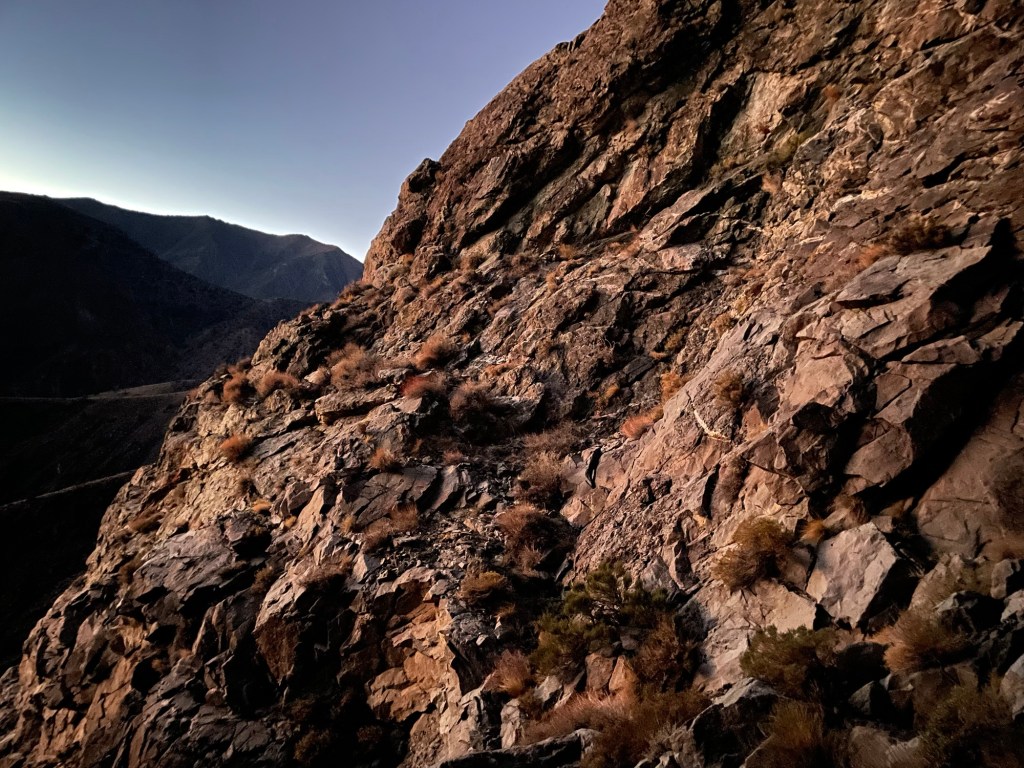
So each day, during the middle of the day I would just take my sleeping pad, which had a pinhole leak in it. I would just keep blowing it up and hold it over the top of me, just to shield myself from the sun. I only had maybe two hours of direct, intense beating sun on me before it went below the rocks on the other side. So, it could have been worse.
By the end of Friday, I ran out of water. From the beginning I was bottling my urine because I knew I was gonna have to… Friday evening I had a beer and I drank that, and then it was just urine from then on. I knew from a wilderness survival course I had taken at the U of O in Eugene, that if you’re ever in this situation, you absolutely should drink your own urine.
But, you know, drinking your own urine will ultimately put you in renal failure, kidney failure. You’re taking back in all of the toxins that your kidneys are trying to filter out. And that’s not good, but you need water to survive, right? Those toxins will kill you much more slowly than a lack of water. If you’re in that situation, you absolutely should recycle your urine. I tried filtering it with my water filter but that didn’t do anything for the taste.
I had like a full bottle in my backpack, and when I reached in to grab it, I noticed that my sleeping bag was just soaking wet and I was like, “No! No! I didn’t screw the lid on all the way!” So it had leaked all over my sleeping bag. I now have a wet sleeping bag and that much less water, right? And so I was like, “well, I can’t let this go to waste. So like here goes nothing.” So I just wrung the sleeping bag out into my mouth.
Anyway, from then on, it was just… bottled urine.
Friday came and went, Saturday came and went. Sunday morning, I’m like, “Okay, Sunday.” That’s go time. The way I expected this to play out, my partner would call the sheriff Sunday morning and they would immediately dispatch a helicopter. They would just follow my route and then within a few hours they would find me, because I’m pretty close to my route. Like, not right on it, but I think I’m close enough to it, I think they’ll probably find me.
So, at first light I laid out all my brightly colored gear- my bright yellow sleeping pad, flipped my sleeping bag inside out. It’s bright orange, I had a bright red jacket, no signal mirror. But yeah, I had all that stuff. So I’m laying there and I’m just like, waiting and I’m listening.
I could hear the sounds of like fighter jets off in the distance because we’re pretty close to China Lake Naval Air Station, which, if you do much hiking in the southern Sierra, or Death Valley, this is kind of the bane of people’s nature experiences- these fighter jets that are just like doing their thing all day long. And all I can hear is fighter jets and no helicopter. And the day is wearing on and still nothing.
By mid afternoon, I’m like, “ok, this is not going according to plan. They might not be coming. I need to start entertaining the notion that like, no one is coming. And that filled me with this profound sadness, right? Like it was, “ok, I have to start dealing with the fact that I might die out here.”
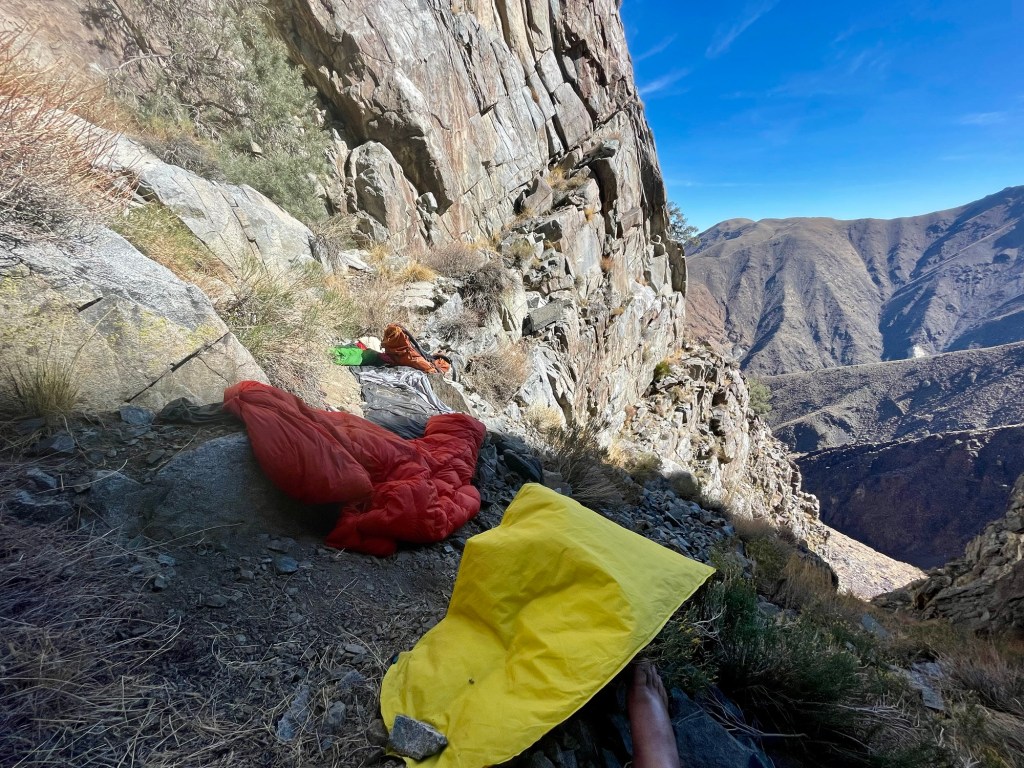
Up to this point, I was just kind of minimizing brain activity, minimizing physical activity just like… trying to be in this half asleep state where I’m consuming as few calories as possible and not worrying… Just laying there and expecting the best. But at this point… the best didn’t happen. So, now what?
And I just started imagining like, man, what if I never get to hug my mom again? What if I never get to kiss my girlfriend again? You know… never get to see any of my loved ones ever again. I had a journal with me and I just started writing short little goodbye letters to all of my closest people and telling them what I loved and admired about them. Things I had really never found the courage to tell them in real life, especially my family members. But I just wrote it down so that I wouldn’t die without this ever having been said at least. And I recorded some voice memos on my phone.
I was thinking, “ok, well, I’m definitely not gonna die just lying here. There is a spring that’s a mile back and 1500 ft down, and I don’t think I can get to it, but I’m gonna try”. And so I was like, “all right, tomorrow morning, first thing, I’m just gonna try this.” Thankfully, Sunday night the pain had started to kind of subside a little bit.
And so, thankfully, by Monday morning the pain was a bit more numb and it was overcast for the first time. The biggest fear I had was exerting myself and being fully exposed to the sun. I was gonna dry out a lot quicker and I didn’t know how many refills I had in me. But I had to try and thankfully it was overcast.
So, I tied a couple of socks around my right foot and ankle just to try to stabilize it a little bit. I put my pack on and I started just lowering myself down, on hands and butt, trying to keep all the weight off both my feet. Pretty quickly, the backpack wasn’t working, so I had to take it off and tumble it down ahead of me. Sometimes it would roll like 20 ft, sometimes it would roll 100 ft and I just had to go catch up to it wherever it landed. Because that had my water–I mean urine–and like my jacket and everything. So, that’s what I did, very slowly, down this sketchy slope, and it was ok. By mid afternoon I’d made it maybe a third of the way down to this water source.
I was definitely not going to make it there by that night, but I was still in a fairly clear head space. I was really low on calories and had low blood sugar. I was all out of wet food. All I had was dry food. So I did the only thing I could, which was like, pour some piss into a packet of oatmeal–brown sugar cinnamon oatmeal–and just hold my nose and eat it. And, uh, I did and it was not that bad actually… relatively. I had that morning tried some Carnation Instant Breakfast… Oh, man, that was no good. I downed it but… I nearly vomited. It was bad.
Anyway, I was able to keep it down and I had this sugar high a little bit. I kept going, but the sun was getting low and then at some point I heard what I was pretty sure was either a single engine airplane or a helicopter. And then I was like, “I think that’s a helicopter” and then it got closer and closer and then this helicopter just like, appeared down below me where the canyon I’m in meets the next one over, the one that I came down prior. This orange and white helicopter.
And I’m like, looking down and I have my red jacket with me and I’m waving it, and just screaming at them and they sit there for a minute and then they just continue down this other canyon toward the Saline Valley floor, which is not my route. So, I’m like, “why are they going this way? That’s not the right way.” I’m like, “fuck, ok, well, they’ve gotta come back up”. Maybe 20 minutes later, they come back up to that same spot. They hover for just a brief second. I’m waving at them again with my jacket, but then they disappear behind the ridge and then they’re gone up the other canyon.
I’m like, “Ok, why did they do that?” That’s not the right way, and what if that was it? What if that was my only chance? I had to then immediately dismiss that thought. It’s like, “Ok, well, then you’re in the same boat you were in 30 minutes ago, which is that you need to get back to that water source because if you can get there, someone will eventually find you. You just need water.”
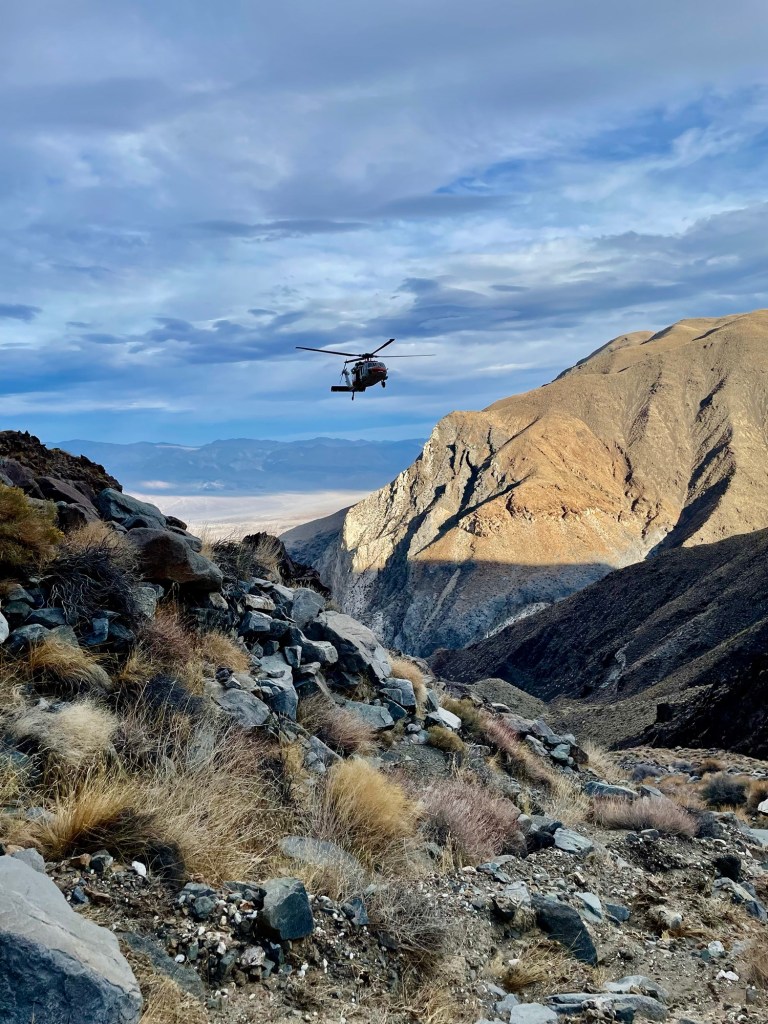
I just tried to put it out of my head. I just kept going and… I don’t know, maybe 30 minutes or an hour later… it was silent and then just out of nowhere, this helicopter just comes right over the ridge, right behind me. This was a big helicopter that says NAVY RESCUE on the bottom.
And I just remember being so elated. And just waving, like, “Can you fucking see me?” And the pilot waved back at me. It was this euphoria I’ve never experienced before and will probably never experience again–hopefully. Where it’s just like… “I’m definitely gonna live. I’m for sure gonna live.”
My phone still had some juice, so I pulled it out real quick and snapped a couple photos at this moment. They’re pretty sweet, kind of epic photos. Certainly the most epic ones I’ve ever taken on a hike.
And so, the helicopter went down and turned around. They were, I guess, figuring out what their strategy was gonna be and then it came back up, dropped a dude down on a cable in an orange jumpsuit. He landed pretty hard and kind of tumbled a little.
And I was like, “Oh shit! Are you okay?”
And he’s like, “yeah, yeah, I’m fine, uh… I was gonna ask you the same thing!”
I was like, “Yeah, I mean, kinda, you know, except for my feet. Man, I’m so happy to see you!”
He was like, “I’m so happy to see you, too!” and we just gave each other a big hug and it was really cool. Like, he was stoked. He did his whole assessment of me and then he said, “We’re actually pretty low on fuel. We were headed back to base. We definitely have enough to get you out of here. But I don’t know if we have enough to carry your pack up separately. Are you ok leaving your pack here?”
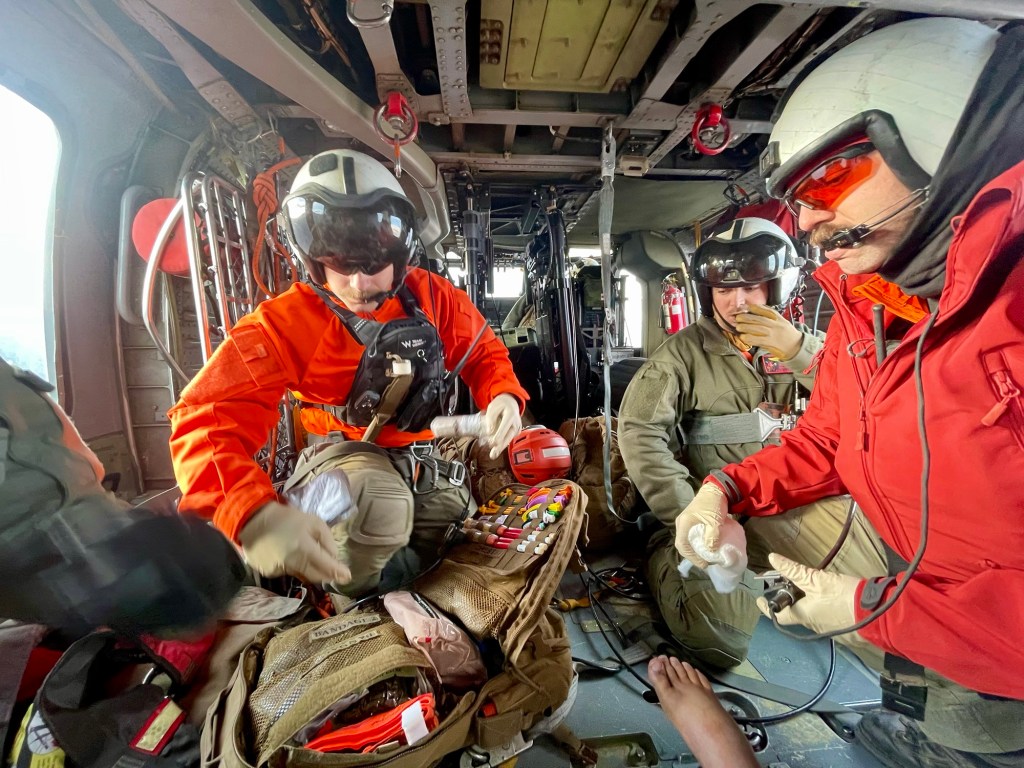
And I was like, “Well, if I’m not gonna die, I’d love to keep my gear.” He radioed back up and they’re like, “yeah, yeah, we can do it.” They hoisted my pack up and then sent a sling down that I kind of climbed into and then they hoisted us back up, and then I had to kind of scramble through the open side of this Blackhawk helicopter.
And then away we went.
There were five people on board, three paramedics. I’m just sitting on the floor of this helicopter just looking out at the most epic sunset, with the High Sierra, Mount Whitney, to my left and then the white sand Saline Valley and Death Valley beyond to my right. And it’s golden hour. It’s like, damn, this is the sweetest ride, people would pay a lot of money for this helicopter ride. And I was like, “I hope I don’t have to pay a lot of money for this helicopter ride.”
The paramedic got the IV in me on the first try and so they’re dripping fluids into me. And they still haven’t given me any water. I’m like, “hey, do you guys have any water by any chance? And they’re like, “oh yeah, yeah, throw him a bottle of water.” This guy tosses me a water bottle. I’m just downing this thing and paramedic’s like, “take it easy, you’re not supposed to drink water that fast when you’re super dehydrated.”
They told me that they didn’t expect to find me alive. They thought that my red jacket I was waving was my tent, like, hanging from a tree, blowing in the wind or something. They couldn’t believe that I was still alert and oriented, after, you know, 94 hours since my fall and 108 hours since I started hiking. We landed at the Bishop airstrip and there was an ambulance there waiting. They put me on a gurney and I was like, “How much is this gonna cost me?” And he was like, “Don’t worry about it, your tax dollars already paid for it.” I was like, “Hell yeah. Um, how do I get your job?” And he’s like, “You gotta join the Navy, bub!”
[laughs]
I was like, “No, I don’t wanna join the Navy.” [laughs]
With so many hard things, if you just commit to the thing and you just decide failure is not an option, then like a lot of times your mind will subconsciously do the things that it needs to do to like grab that next hold or do that skateboard trick or whatever.
They whisked me off in an ambulance to the hospital. I was in acute renal failure, my kidneys had shut down. My other organs would have started shutting down in succession after that. And that would have killed me at some point. My right foot had a super complex fracture that the orthopedic surgeon at this rural hospital in Bishop was like, “I could operate on you, but you don’t want me to. You need to go see a specialist at a research hospital.” My left ankle had a ligament injury and some other little cuts, bruises, micro fractures throughout my body.
My mom and sister came and picked me up from Texas, drove me back home to Oakland. I got in to see one of the top foot and ankle surgeons in the country, at UCSF. Even though I was on Medicaid at the time, I got a $180,000 bilateral foot surgery for free with a really good surgeon. She did an excellent job. She got all my bones back in perfect alignment. She fused three joints, put in a ton of hardware, some pretty precision carpentry in my right foot. When you look at the x-rays, there’s a lot of screws and plates in there.
I was in a wheelchair for three months, then crutches for three more months after that. And then on to the recovery. But that’s another story.

NORTHER: How far did you fall?
AARON: The free fall I would estimate at about 15 t and then the tumble after that was somewhere between 20-30 ft.
NORTHER: Oh my God, that’s so far.
AARON: Yeah, it was a lot. I mean, people do survive epic falls but yeah, even a 5 ft fall can kill you.
NORTHER: You had a full pack, so that kind of like protected you, right?
AARON: Yeah, it protected my spine. So, I had no spinal injury, which was amazing. I got lucky and didn’t hit my head, either.
NORTHER: Yeah, that’s crazy. I mean, to fall that far and not have any spinal injury is wild.
AARON: My foot is what caught pretty much my whole body weight. So, you know, better your foot to break the fall than your back. The backpack helped and then I just happened to not hit my head so it was a totally repairable injury.
NORTHER: So, something that I noticed when you were telling the story is that when you were talking about the sort of… unhinged behavior that got you into this situation- that you were working with this kind of delusional level of self belief… It’s also sort of what helped you keep your shit together through the worst of it, because you’re able to… go wherever you need to go in your head to not freak out.
That is a very long time to be in a lot of pain and not really sure if you’re going to live or die. Some people in your shoes would have folded, mentally.
Most people aren’t able to compartmentalize like that and just tell themselves, “I’m going to get rescued in this many hours. This is what’s gonna happen.” I feel like those things are like two sides of the same coin.
AARON: That’s an interesting insight and not something I’ve really thought about before, but I think you’re right. I think it was that delusional self belief that definitely benefited me. It was just, like, irrational optimism.
I’ve always kind of described myself as an irrational optimist. I think it’s generally one of my better qualities, but it doesn’t always benefit me, for sure. More often than not, it does. I guess that’s maybe the quality that’s at the heart of that and it helped me maintain this crucial belief that I was gonna survive.
NORTHER: I don’t know if this resonates with you, but I am someone that got into doing hard shit in mountains in my mid-thirties. Part of the interest for me was that I was just so interested in where the line was, what I was physically and mentally capable of? I found out I’m good at this thing called endurance because I am really good at controlling my inner experience. So, I can walk 40 miles in a day, no problem, but that journey is mental as much as physical.
I was never interested in sports or running or anything until I realized it was a mental game. And then I was like, really fucking interested. [laughs]
AARON: We all have physical limits somewhere. But, our brain is the only thing between us and our physical limits, you know? Generally, most of us don’t push that physical limit because our brain stops us well before we get to that point. But yeah, it’s a cool discovery, it feels powerful, and it’s fun to play with. When you know that you have the power to just keep pushing and do something really hard that you didn’t think you could do.
NORTHER: How much of your ability to survive in that situation was based on your experience and skill as an outdoors person and, how much of it was just sheer grit and willpower?
AARON: I mean, it was my experience and skill as an outdoors person that got me into the situation to begin with, right? And my overconfidence in myself… I forgot, what was the term that you used? How did you describe it?
NORTHER: Oh, delusional self belief! This is something I talk about in a positive way. As an entrepreneur, you have to carry a delusional level of self belief. Otherwise, the weight of other people’s doubts will just crush you.
AARON: Yeah. Especially doing something like you’re doing, kind of a novel idea. Hell yeah, I love that.
I’m more apt to catch myself when I’m evaluating a risk and immediately dismissing it as unlikely
It’s a great quality. It’s both what allows me to do hard things that most people I know wouldn’t attempt and have these really special experiences. And yeah, and it’s also something to be aware of when it leads you astray, when it leads you to do things that are dangerous. Just because you think you can do something, doesn’t mean you should.
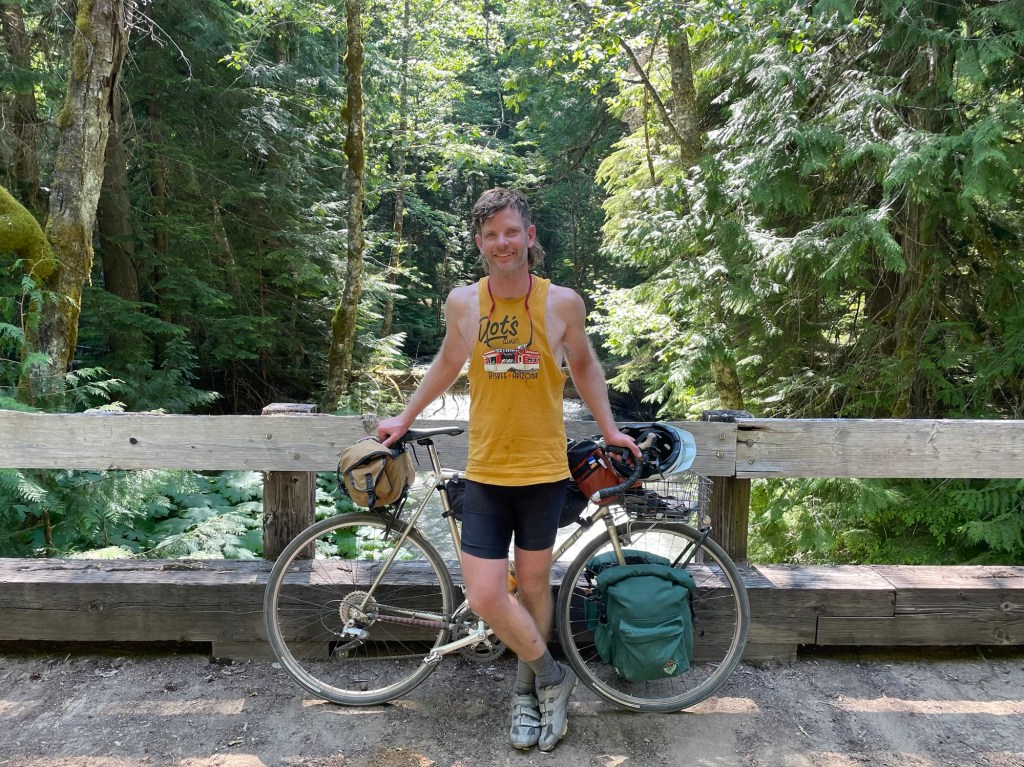
As someone who has a pretty high risk tolerance in general, I have to temper my belief that everything will be ok with the knowledge that it might not. That’s why I wear a helmet when I ride my bike, because I know what might happen if I hit my head. I think this experience really drove that point home for me.
NORTHER: How has this accident changed the way you spend time outdoors?
AARON: I haven’t done a solo off-trail hike since then, which has as much to do with the fact that, at least for a long time afterwards, my foot was hurting when I would hike longer distances. That’s actually kind of subsided. But in its place I’ve been doing more bikepacking and doing that by myself sometimes. All the activities that I do on my feet, walking and running, are the hardest now.
I’m more apt to catch myself when I’m evaluating a risk and immediately dismissing it as unlikely. I’m more likely to second-guess that instinct, and give a situation a second look. Is there another way I could do this more safely?
That plays out too, in my work as a carpenter and now a project manager who also leads projects in the field in remote places. I have to evaluate risk all the time. And, yeah, I’m a bit more cautious than I used to be.
NORTHER: What are you looking forward to for your future as an outdoors-person?
AARON: Mmm. That’s a good question. I think I am first and foremost an explorer. I love to explore new landscapes, new places that I haven’t seen. I’m most excited about doing some bikepacking trips outside the US. I wanna do one in southern Mexico next year. I think in general, the thing that orientates me towards outdoor activity now is just having fun with friends, most often on bicycles and in remote places. That’s kind of my favorite thing these days. I’ve been building new friendships around that and finding some community around that and I think that’s what excites me the most these days.
NORTHER: Hey, thanks so much for talking with us today. I’m glad you didn’t die out there, friend.
AARON: Thank you. This was really fun.

 Wild Solitude